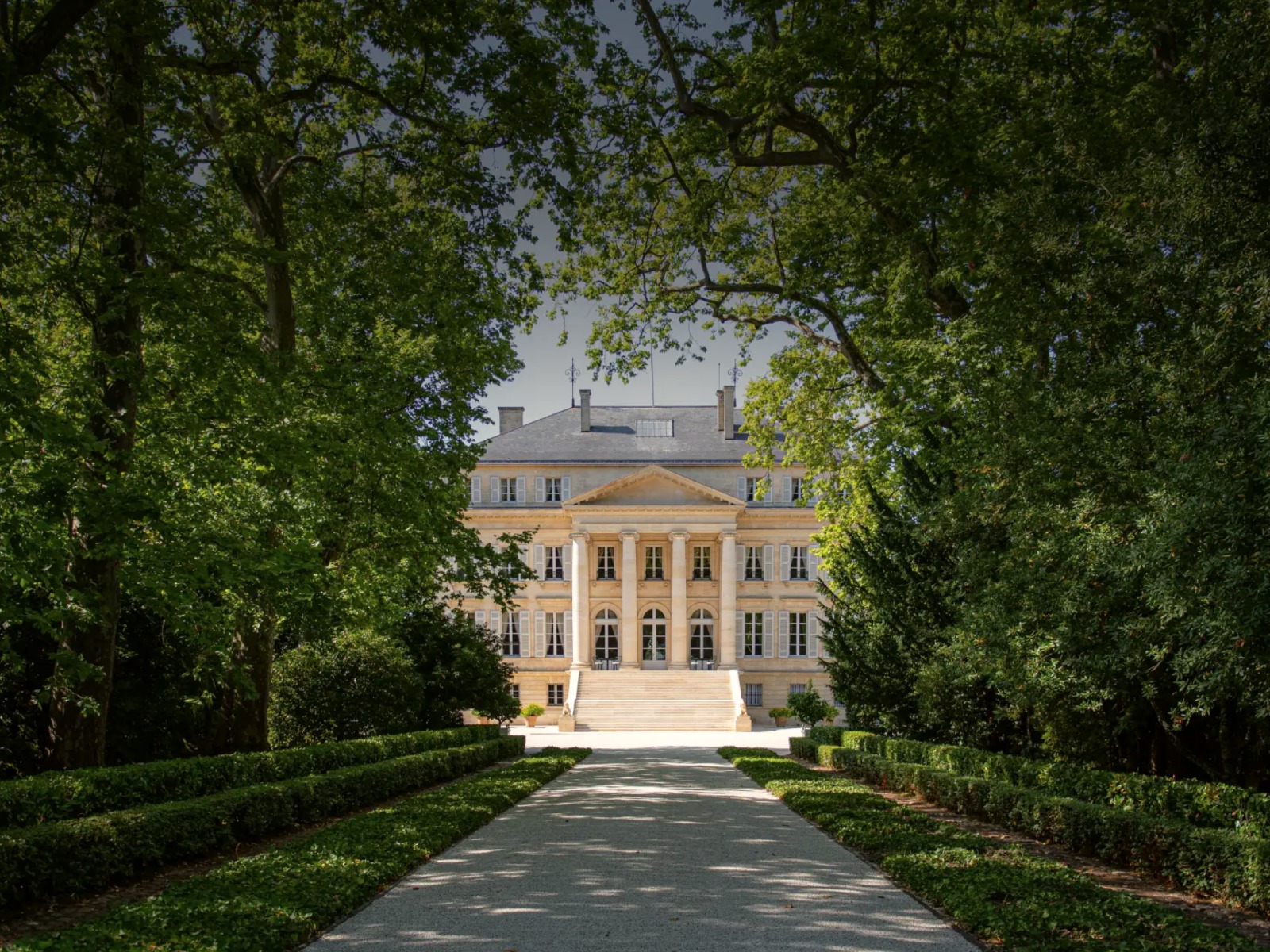
First growth Bordeaux means one of five estates: Château Lafite Rothschild, Château Latour, Château Margaux, Château Haut-Brion and Château Mouton Rothschild. They occupy the top tier of the 1855 Classification of the Médoc, a ranking that has been changed exactly once in 170 years. Together they account for a small fraction of Bordeaux’s output and a large share of its value.
This guide covers what the classification actually measures, who the five are, why the label still moves prices in 2026, and what a collector needs to know before buying a bottle.
What “first growth” actually means
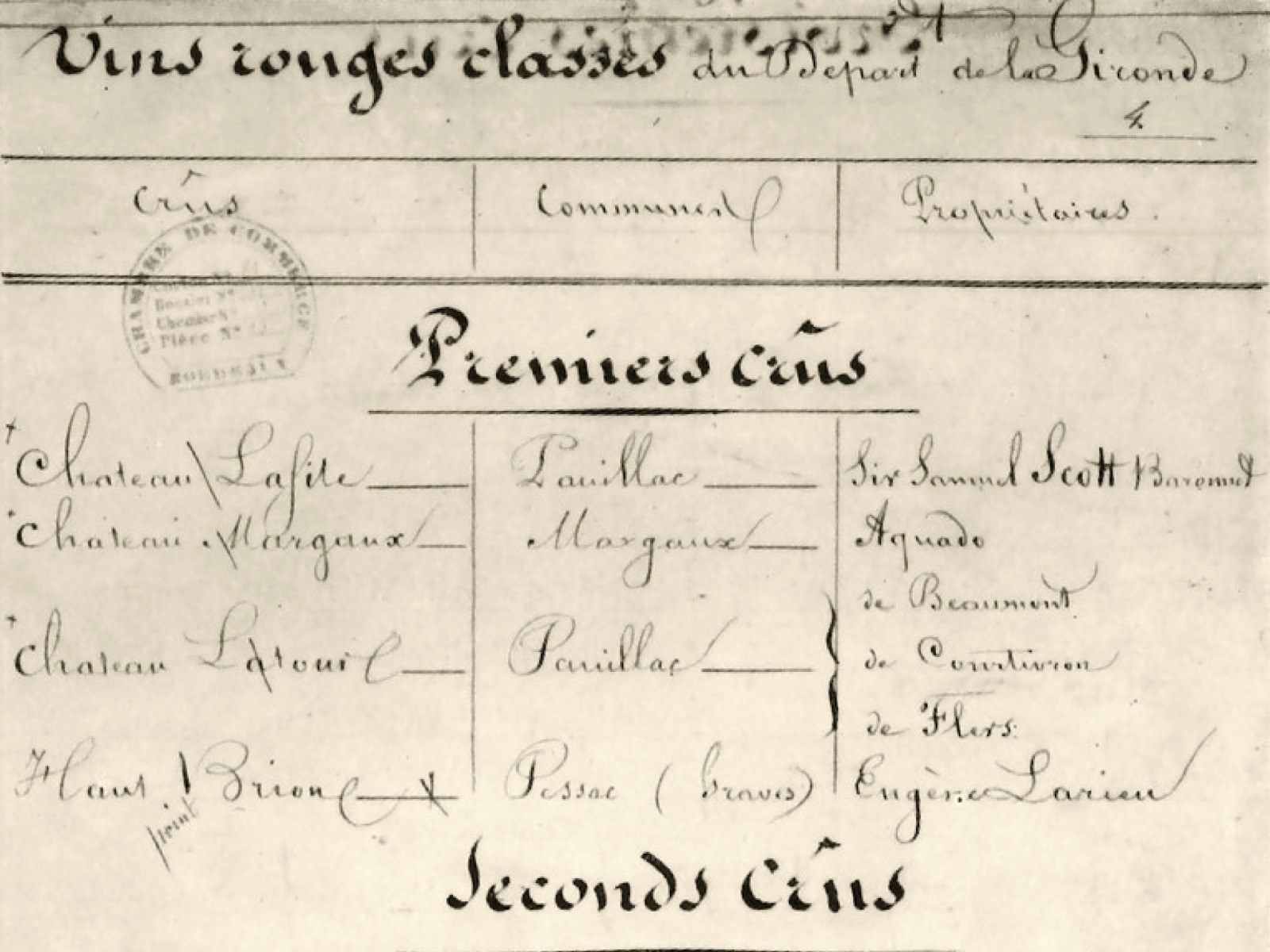
The term is a translation. In French it is premier cru classé, literally “first classified growth.” It comes from a single document drawn up in 1855.
The 1855 Classification, in brief
Napoleon III wanted a ranking of Bordeaux’s best wines for the Exposition Universelle in Paris. The task went to the courtiers, the brokers who handled the Bordeaux trade and knew precisely what every estate’s wine fetched. They did not taste comparatively or score anything. They ranked estates by reputation and, above all, by the prices those estates had been commanding for decades.
The result was five tiers of red wine, from premier cru down to cinquième cru. Four estates made the top tier: Lafite, Latour, Margaux and Haut-Brion.
Two things about that list are worth holding onto.
The first is that it is a price list, not a quality verdict. The courtiers were recording a market, and the market had already decided. This is why the classification has aged better than anyone expected: it was built on a century of trading data, not on one committee’s palate.
The second is that it covers only the Médoc, plus one estate. Haut-Brion sits in Graves, now Pessac-Léognan, and was included because it was impossible to leave out. Everything on Bordeaux’s Right Bank (Saint-Émilion, Pomerol) was simply outside the brief. More on that below, because it is the single most common misreading of the list.
The one change in 170 years
In 1855, Château Mouton Rothschild was ranked a second growth. Baron Philippe de Rothschild spent most of his life objecting to this. His estate’s motto said so plainly. Premier ne puis, second ne daigne, Mouton suis: “First I cannot be, second I do not deign to be, Mouton I am.”
In 1973, after decades of campaigning, the French agriculture ministry promoted Mouton to first growth. The motto was rewritten. Premier je suis, second je fus, Mouton ne change: “First I am, second I was, Mouton does not change.”
That is the only revision to the top tier in the classification’s history. It tells you how much institutional weight the 1855 list carries, and why a promotion is worth campaigning forty years for.
First through fifth: the rest of the ladder
“First growth” only means something against what sits below it. The 1855 Classification ranked 61 estates across five tiers:
| Tier | French | Estates | Notes |
|---|---|---|---|
| First growth | Premier cru classé | 5 | Lafite, Latour, Margaux, Haut-Brion, Mouton |
| Second growth | Deuxième cru classé | 14 | Includes the “super seconds”: Léoville-Las-Cases, the two Pichons, Cos d’Estournel, Montrose, Ducru-Beaucaillou |
| Third growth | Troisième cru classé | 14 | Palmer is the famous anomaly: third growth on paper, first growth prices in strong vintages |
| Fourth growth | Quatrième cru classé | 10 | Includes Duhart-Milon, run by the Lafite team |
| Fifth growth | Cinquième cru classé | 18 | Includes Pontet-Canet and Lynch-Bages, both of which routinely outperform their rank |
The gap between tiers is where the interesting buying happens. At the top, the ranking has held up remarkably well. The five first growths are still, by consensus and by price, the five most important estates on the Left Bank. Further down it has drifted. Estates have changed hands, replanted, rebuilt, and in some cases transformed completely, and the 1855 label has not moved with them. A fifth growth run brilliantly today can be a better wine than a third growth coasting on its rank.
That drift is not a flaw in the classification. It is a 170-year-old price list and it never promised to be updated. But it does mean the label tells you what an estate was worth in 1855, not what it is worth now.
The five first growth châteaux
| Estate | Appellation | Dominant grape | Character in one line |
|---|---|---|---|
| Château Lafite Rothschild | Pauillac | Cabernet Sauvignon | Restraint and perfume; the most aromatic of the five |
| Château Latour | Pauillac | Cabernet Sauvignon | Power and structure; the longest-lived |
| Château Margaux | Margaux | Cabernet Sauvignon | Silk and florality over force |
| Château Haut-Brion | Pessac-Léognan | Cabernet Sauvignon / Merlot | Smoke, earth and warmth; the outlier in style and place |
| Château Mouton Rothschild | Pauillac | Cabernet Sauvignon | Opulence and depth; an artist label every year since 1945 |
Three of the five are in Pauillac, a commune of deep gravel soils on the Left Bank that drains fast and ripens Cabernet Sauvignon reliably. That is not a coincidence. The 1855 ranking is, read sideways, a soil map.
Château Lafite Rothschild, Pauillac
Lafite is the first growth people reach for when they want to describe elegance rather than power. The wines are built on Cabernet Sauvignon but carry a cedar-and-violet lift that sets them apart in blind tastings. They are also the slowest of the five to show what they are: a great Lafite at ten years old is frequently misread as merely good.
Vintage Cellar holds Château Lafite Rothschild, and there is more on the estate’s history and vintages on our Château Lafite Rothschild, Pauillac producer page.
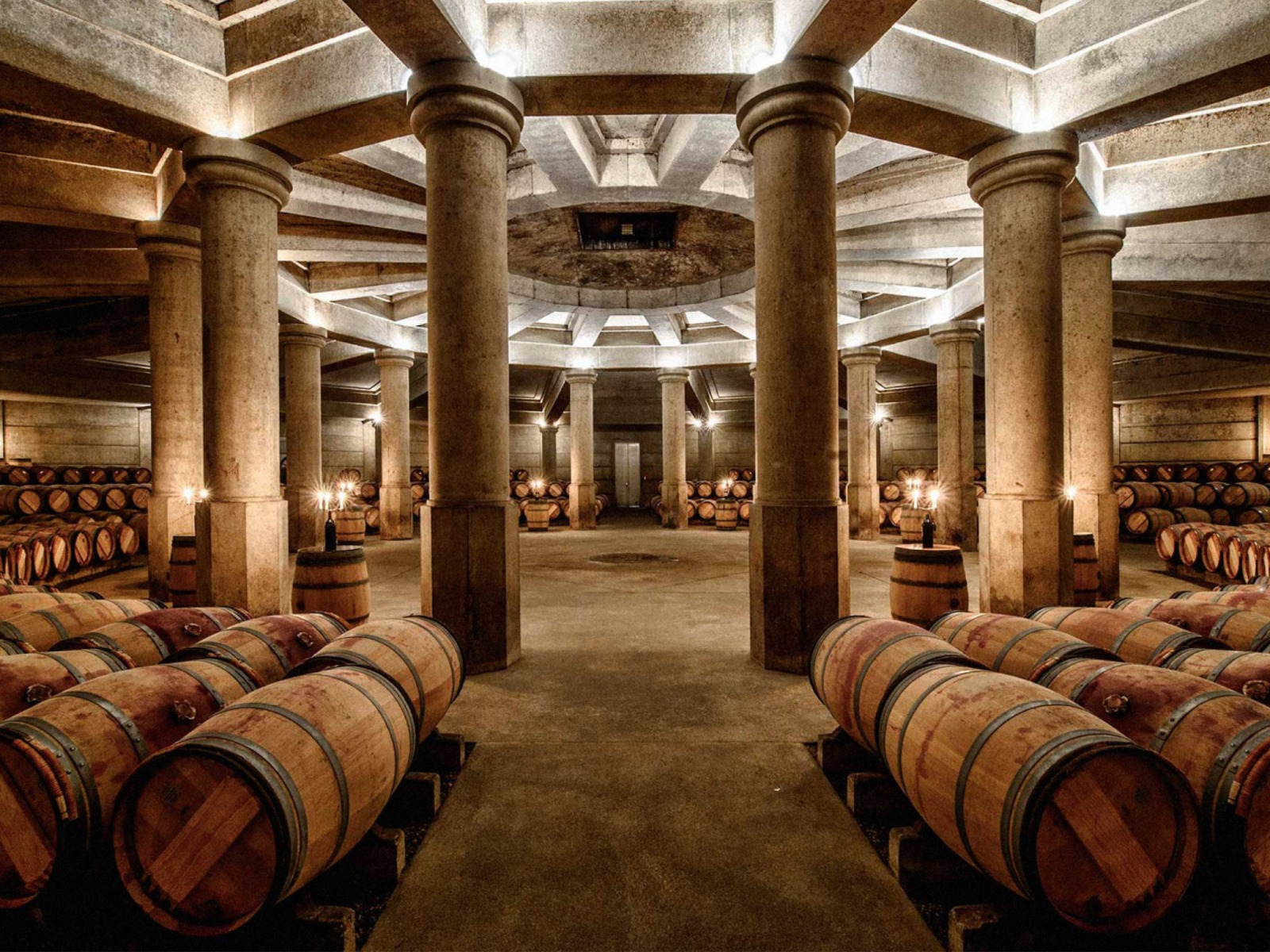
Château Latour, Pauillac
If Lafite is perfume, Latour is architecture. The estate sits on the southern edge of Pauillac close to the Gironde, and its wines are the most structured and the most patient of the five. Latour is also the estate that walked away from the Bordeaux en primeur system in 2012; it now releases its wines only when it judges them ready to drink, which has made its back vintages unusually well-provenanced.
We hold Château Latour Premier Cru Classé. See also the Château Latour, Pauillac producer page.
Château Margaux, Margaux
Margaux gives its name to its commune and makes the most overtly beautiful wine of the five. The soils are lighter and the gravel shallower than in Pauillac, and the wines show it: floral, fine-boned, built on texture rather than muscle. Weaker vintages can be slight. Strong ones are among the most seductive wines made anywhere.
Château Haut-Brion, Pessac-Léognan
Haut-Brion is the exception in every direction. It is the only non-Médoc estate in the 1855 red classification, the smallest of the five, and now effectively inside the Bordeaux suburbs. Its vineyards hold more Merlot than its Pauillac peers, and the wines carry a distinctive warm, smoky, almost savoury note that collectors recognise instantly. It is also the oldest brand in fine wine: Samuel Pepys was drinking “Ho Bryan” in 1663.
Our note on the current release is at Haut-Brion 2025 En Primeur.
Château Mouton Rothschild, Pauillac
Mouton is the most immediately generous of the five: dense, opulent, built to be impressive. It is also the most collectable as an object. Since the 1945 victory vintage, every label has been commissioned from a different artist (Picasso, Bacon, Warhol, Koons, Murakami), which means Mouton attracts buyers who are not primarily wine buyers at all. Complete label collections trade as sets.
See Mouton Rothschild 2025 En Primeur for the current vintage, and our piece on the Dom Pérignon × Takashi Murakami collaboration for more on art-label collecting.
Why first growths hold value
Four mechanics, and they compound.
Scarcity that cannot be expanded. A first growth’s production is capped by the size of a classified vineyard. Demand can triple; supply cannot. No new first growths have been created since 1973, and the 1855 framework provides no mechanism for making one.
A shrinking pool. Every bottle drunk is gone. For a wine like Lafite 1982 or Latour 1961, the quantity still in sound condition falls every year while the number of people who want one does not.
Liquidity. These five are the most frequently traded names in fine wine. That matters more than most collectors expect. A wine that is excellent but obscure can take months to sell at a fair price; a case of first growth in good condition can be moved in days. Read our guide to selling a fine wine collection without losing value for how that plays out in practice.
The label itself. “First growth” is the most durable quality signal in wine. It survived two world wars, phylloxera, the 1970s Bordeaux scandal and the 2011 Asian price correction. Brand equity that old is its own asset.
For the broader picture of which wines behave this way, see our guide to blue-chip wine.
What the 1855 list does not cover
This is where the term misleads people, so it is worth being precise.
There are no first growths on the Right Bank. Pétrus is not a first growth. Nor is Cheval Blanc, Ausone, Le Pin or Angélus. The 1855 Classification covered the Médoc and Haut-Brion, full stop. Saying “Pétrus is a first growth” is roughly like calling a Ferrari a Formula One car. It reaches for the right register and names the wrong category.
Saint-Émilion runs its own classification, and it moves. Saint-Émilion’s top tier is Premier Grand Cru Classé A, and unlike 1855 it is revised roughly every decade. That has consequences.
The 2012 classification had four estates at the top: Ausone, Cheval Blanc, Angélus and Pavie. Then three of them left. Cheval Blanc and Ausone announced in July 2021 that they would not stand as candidates for the 2022 revision, objecting that the criteria had drifted away from terroir toward things like wine tourism numbers and social media reach. Angélus withdrew as well. The 2022 classification therefore lists just two Premiers Grands Crus Classés A: Pavie, which retained its rank, and Figeac, newly promoted.
Not one of those wines changed. The paperwork did. Ausone, Cheval Blanc and Angélus command the same prices and the same respect they did before they walked away, which is the clearest possible demonstration that at this level the market, not the committee, sets the hierarchy. Collectors who buy the label rather than the bottle got a useful lesson in the difference.
We hold both Château Cheval Blanc and Château Angélus, with background on our Cheval Blanc and Angélus producer pages.
Pomerol has no classification at all. None. Pétrus and Le Pin sit at the top of the Pomerol hierarchy on reputation and price alone, which is, of course, exactly what the 1855 courtiers were measuring. The absence of a ranking has done nothing to hold Pomerol prices back.
Graves has its own 1959 list. Château Smith Haut Lafitte, which we hold in both red and white, is a Grand Cru Classé de Graves, a separate classification from 1855 and from Saint-Émilion.
Three routes in for collectors
Back vintages in bottle
Buying a mature first growth is the most direct route and the one with the most traps. You are buying two things: a wine and a history. The wine is usually fine. The history (where the bottle has been for thirty years, at what temperature, in whose hands) is what decides whether it is worth what you are paying.
This is the part of the market where an intermediary earns their fee. Our notes on trusted wine provenance and how to identify fake wine set out what we check before a bottle enters our catalogue.
En primeur
En primeur means buying a vintage in barrel, one to two years before it is bottled and shipped. For first growths the case for it is narrower than the marketing suggests: in weak and average vintages the release price frequently exceeds what the wine trades for later, and you have paid years in advance for the privilege. In genuinely strong vintages, and for the specific wines with the longest track records, it can still be the only way to secure an allocation at all.
Our current coverage is at Lafite Rothschild 2025 En Primeur, Mouton Rothschild 2025 and Haut-Brion 2025.
Second wines and the adjacent growths
The most sensible first move for most new collectors is not a first growth at all.
Second wines come from the same estates, the same teams and often adjacent parcels, at a fraction of the price. Carruades de Lafite-Rothschild is Lafite’s second wine. Les Forts de Latour is Latour’s. They are not first growths and should not be bought as substitutes, but they are the cheapest honest way to learn what a house style tastes like.
The adjacent growths are where the 1855 drift described earlier turns into value. Château Duhart-Milon is a fourth growth Pauillac that has been run by the Lafite team since 1962. Château Pontet-Canet and Château Lynch-Bages are fifth growths whose recent form has embarrassed estates ranked above them. And the informal “super seconds” (Léoville-Las-Cases, Pichon Baron, Cos d’Estournel) make wine at first growth standard without the first growth tariff.
If you want one rule of thumb: buy the first growths for the certainty and the liquidity, and buy the second through fifth growths for the wine.
Provenance decides what your bottle is worth
Two bottles of the same first growth, same vintage, can differ in price by a factor of three. The wine is identical. What differs is the evidence.
What a serious buyer checks: unbroken storage history at stable temperature and humidity; fill level appropriate to age; label and capsule condition; original wooden case where it should exist; and a documented chain of custody rather than a vague “from a private cellar.”
If you already hold first growths, storage is not a detail. It is the asset. See how to choose the right storage for fine wine and our fine wine concierge service, which covers cellar management and insured storage from our Geneva base.
Buying first growth Bordeaux through Vintage Cellar
We currently hold Château Lafite Rothschild and Château Latour in our Geneva catalogue, alongside Carruades de Lafite, Duhart-Milon, Cheval Blanc, Angélus, Pontet-Canet, Lynch-Bages and Smith Haut Lafitte.
Margaux, Haut-Brion and Mouton Rothschild we source to order. That is the ordinary shape of this market: no merchant holds every first growth in every vintage, and anyone who says otherwise is describing a catalogue rather than a cellar. If you are looking for a particular estate and year, whether a birth-year bottle, a gap in a vertical or a case for long-term hold, tell us the target and we will tell you honestly what it costs, what condition is available, and whether we think you should wait.
Browse the current Vintage Cellar selection, or speak to a specialist.
Further reading: our full Bordeaux wine and vintage guide, the best Bordeaux vintages collectors are chasing, and our vintage Bordeaux master ratings.
Frequently asked questions
How many first growth Bordeaux are there?
Five. Lafite Rothschild, Latour, Margaux and Haut-Brion were named in the 1855 Classification; Mouton Rothschild was promoted in 1973.
What are the five first growths of Bordeaux?
Château Lafite Rothschild (Pauillac), Château Latour (Pauillac), Château Margaux (Margaux), Château Mouton Rothschild (Pauillac) and Château Haut-Brion (Pessac-Léognan).
Why is Mouton Rothschild a first growth when it was ranked second in 1855?
Baron Philippe de Rothschild campaigned for promotion for decades. The French agriculture ministry granted it in 1973. It is the only change ever made to the top tier of the 1855 Classification.
What is a second growth Bordeaux?
The second tier of the 1855 Classification: fourteen estates, including Léoville-Las-Cases, Pichon Baron, Pichon Comtesse, Cos d’Estournel, Montrose and Ducru-Beaucaillou. Several are known informally as “super seconds” because they make wine at close to first growth standard. Mouton Rothschild was a second growth until 1973.
Why do the British call Bordeaux “claret”?
From clairet, a medieval Bordeaux style that was paler than modern red wine. Bordeaux was under English rule for three centuries, from Eleanor of Aquitaine’s marriage to Henry II in 1152 until 1453, and both the trade and the name outlived the loss of the territory. In British usage “claret” means red Bordeaux specifically, not red wine in general.
Is Pétrus a first growth?
No. Pétrus is in Pomerol, on Bordeaux’s Right Bank, which the 1855 Classification did not cover and which has no classification of its own. Pétrus sits at the top of the Pomerol market on reputation and price alone.
How long should first growth Bordeaux age?
In a strong vintage, expect fifteen to twenty years before the wine begins to show its full character, and several decades of drinking window after that. Latour is typically the slowest; Haut-Brion often the most approachable early.
Are first growth Bordeaux a good investment?
They are the most liquid and best-documented segment of the fine wine market, which makes them the easiest to value and to sell. That is not the same as a guaranteed return. Prices fell materially after the 2011 Asian peak and took years to recover. Treat them as a long-hold asset with unusually good liquidity, and buy on provenance rather than on label alone.
Vintage Cellar is a fine wine advisory and concierge based in Geneva, Switzerland. We source, store and manage collections for private clients.